What to Expect After Botox: Results, Recovery and Timeline — Botox Aftercare Toronto

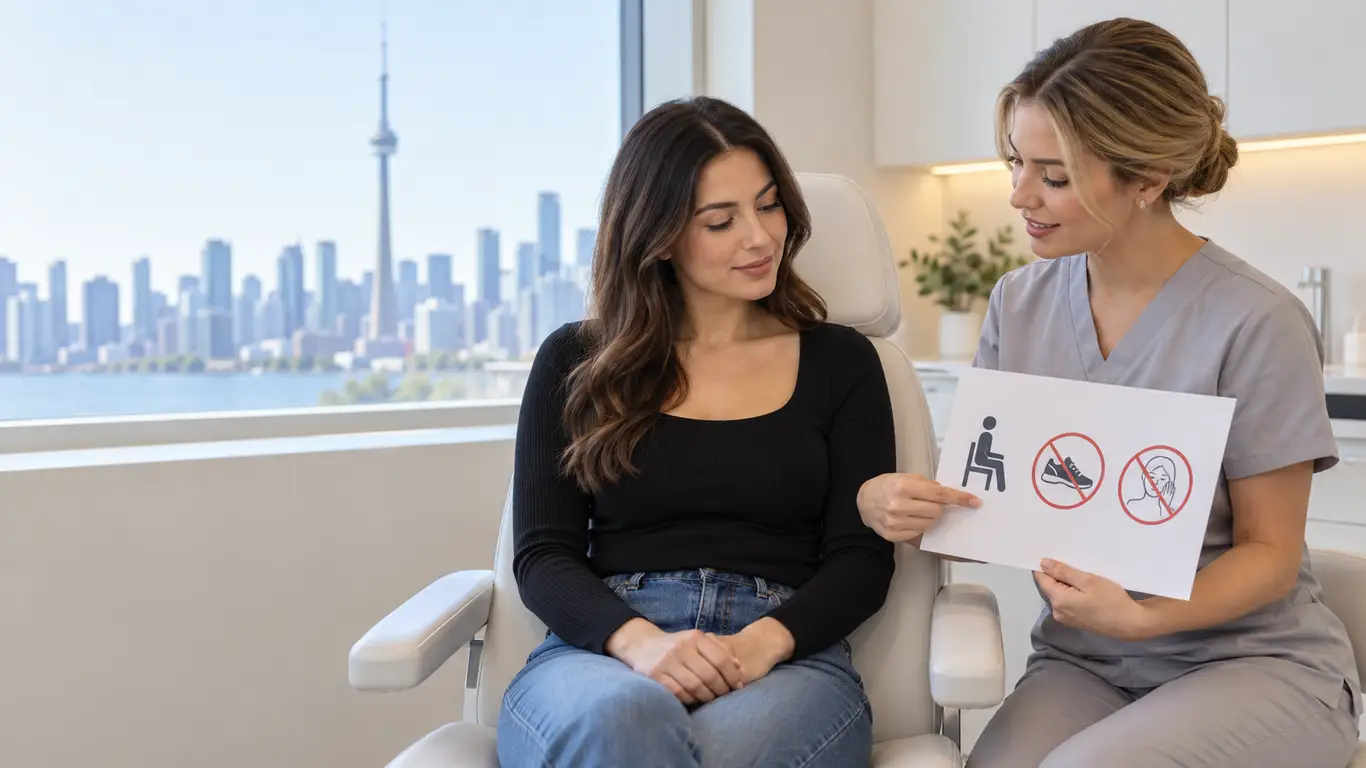
Botox results develop gradually, so your face does not have to look different when you leave the clinic. Your immediate priorities are following the aftercare instructions, planning everyday activities and recognizing symptoms that need attention. This Botox aftercare Toronto guide answers those questions before explaining the results timeline.
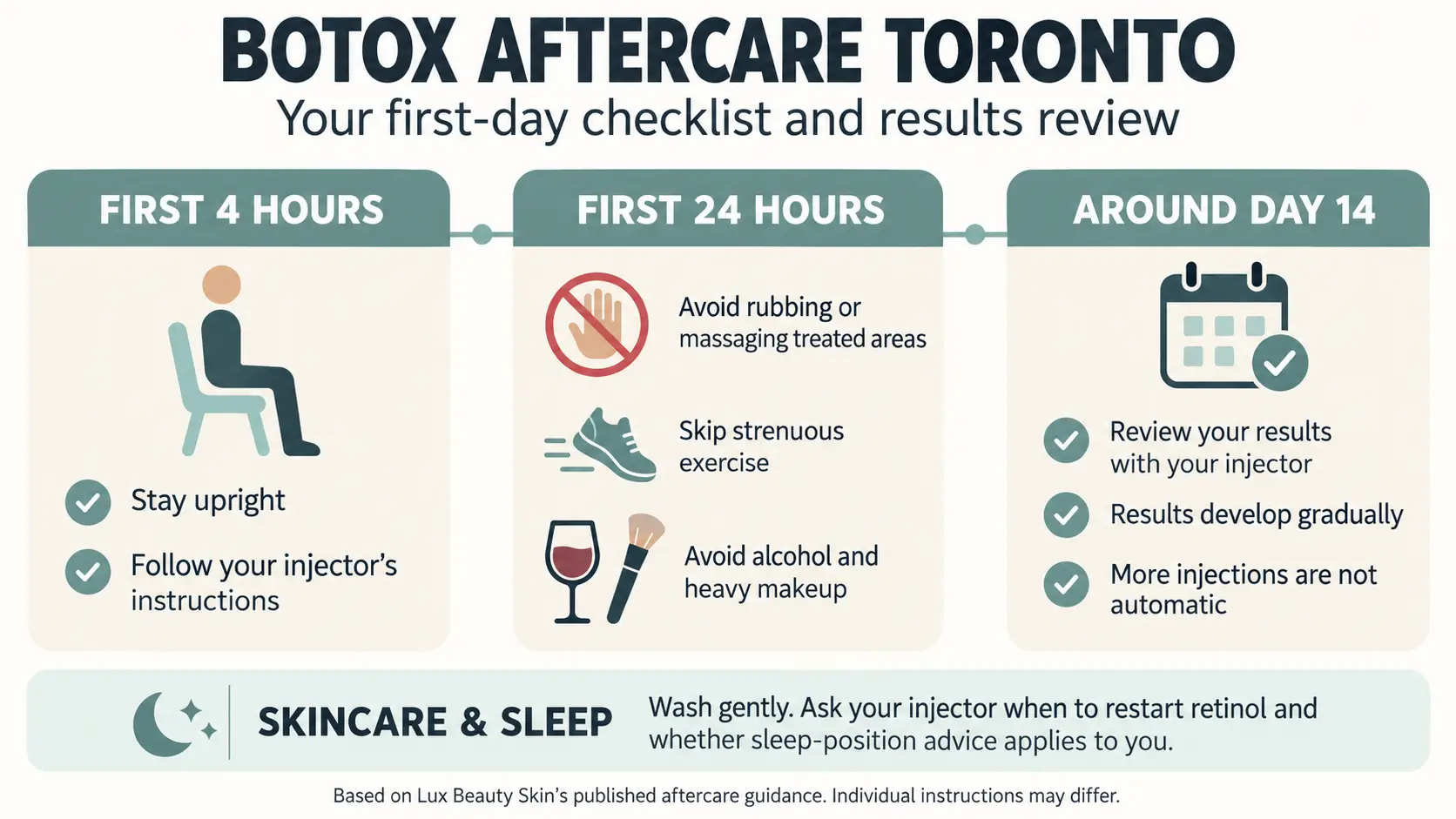
Quick Answer: After cosmetic Botox, follow your clinic’s instructions and avoid rubbing treated areas. Lux Beauty Skin recommends staying upright for four hours and avoiding strenuous exercise, alcohol and heavy makeup for 24 hours. The clinic describes results developing over several days, with a review at about two weeks. Some exact activity cutoffs are precautions rather than universally proven rules; ask your injector about skincare, sleeping positions and any other treatments you received.
Table of Contents
ToggleBotox Aftercare Toronto: Your First-Day Checklist
Start with the instructions given for your own appointment. Patients receiving Botox treatment in Toronto at Lux Beauty Skin are advised to follow the clinic’s four-hour and 24-hour restrictions below.
| Question | Practical starting point |
|---|---|
| How long should I stay upright? | Four hours under Lux’s protocol. |
| When can I return to strenuous exercise? | After the clinic’s 24-hour restriction, unless your injector advises otherwise. |
| Should I rub the injection sites? | Avoid rubbing or massaging treated areas. |
| What about alcohol and heavy makeup? | Lux advises avoiding both for 24 hours. |
| When should I judge the result? | Discuss it at the planned two-week review rather than immediately after injection. |
Keep a copy of your Botox aftercare instructions on your phone. Note when your appointment ended. If treatment finished at noon, the four-hour upright period ends at 4 p.m.
Botox Aftercare Toronto: Why Advice Can Differ
Clinic protocols and medical guidance do not always give identical waiting periods. Cleveland Clinic’s Botox aftercare guidance notes limited evidence that exercise affects how the treatment settles and does not set a universal makeup waiting time.
That distinction matters: follow your treating clinician’s advice, but do not assume every restriction you find online is an established medical rule. If two instructions conflict, ask the clinic which applies to your injection sites and treatment combination.
What Not to Do After Botox
Avoid rubbing or massaging treated areas for 24 hours and follow your clinic’s activity restrictions. The main points are:
- Do not rub or massage injection sites: this includes trying to correct an uneven-looking result yourself.
- Do not change prescribed medicines on your own: discuss any medication concern with the prescribing clinician.
- Do not rush into more injections: report an early cosmetic concern to your treating injector.
- Clarify upcoming facials or massages: explain whether the procedure involves pressure on treated areas.
- Keep combined-treatment instructions separate: Botox advice may not cover filler or another skin procedure.
Botox Aftercare: First 24 Hours
Plan the first day around the restrictions you were actually given. Schedule your gym session, evening drinks or heavy makeup application outside Lux’s 24-hour window rather than trying to combine everything with your appointment.
Make the first day easier to manage:
- Save your written instructions and the appointment’s finishing time.
- Move strenuous workouts, alcohol and heavy makeup outside Lux’s 24-hour restriction.
- Clarify any activity your instructions do not cover, such as a heated fitness class.
- Request additional aftercare if you also received filler, microneedling or another procedure.
If treatment ended at noon, the next day’s noon marks 24 hours—not simply the start of the next calendar day.
Reference Table: 10 Questions to Ask
| Question | What a trustworthy answer should include |
|---|---|
| Who will perform my treatment? | The provider’s name, designation, relevant training, and experience |
| Can I verify credentials? | Clear information about professional registration and clinical role |
| Is there a safety process? | Consultation, consent, hygiene, documentation, and follow-up procedures |
| What products are used? | Product name, purpose, sourcing, and whether it is appropriate for you |
| Is my plan personalized? | An assessment before recommendations, not a preset package |
| Can you explain alternatives? | Honest comparison of options, benefits, limits, and downtime |
| Do your examples match my goals? | Consistent, balanced results without filters or misleading edits |
| What should I realistically expect? | Expected timeline, maintenance, limitations, and possible side effects |
| Is the cost clear? | What is included, how pricing works, and likely maintenance costs |
| What happens after treatment? | Written aftercare instructions and a clear support process |
How Long After Botox Can You Exercise?
At Lux Beauty Skin, the instruction is to avoid strenuous exercise for 24 hours. Ask about your actual workout if you are unsure whether it falls within that restriction.
When asking about a workout, specify:
- Activity: running, strength training, cycling or a fitness class.
- Timing: how many hours after the appointment you plan to exercise.
- Other procedures: any treatment you received alongside Botox.
This helps your injector answer the question for your appointment.
If you exercised sooner than advised, tell the clinic what happened and ask whether any follow-up is needed. The evidence limitations discussed above mean an early workout should not automatically be treated as proof that the treatment failed.
How Long After Botox Can You Lie Down?
Lux advises staying upright for four hours. Mayo Clinic’s post-injection guidance gives a two-to-four-hour waiting period, so Lux’s instruction fits within that guidance.
Choose an appointment time that allows you to complete the upright period before your usual bedtime. For a late-afternoon appointment, calculate the end time in advance rather than trying to guess when it is safe to rest.
If you accidentally lay down earlier, contact the clinic if you are concerned. Explain how long after treatment it happened and whether you have symptoms; do not attempt to compensate by massaging your face.
Can I Sleep on My Side After Botox?
Complete the instructed upright period first. The medical sources reviewed do not establish a universal side-sleeping cutoff, so ask your injector whether your treatment requires a specific sleeping position.
Tell the clinic if you normally sleep on your side or stomach and find other positions difficult. This is more useful than adopting an uncomfortable sleep arrangement from a generic social-media tip.
If you wake up in a different position, it does not by itself establish that anything has gone wrong. Report new symptoms or concerns about your result rather than trying to infer the outcome from your pillow position.
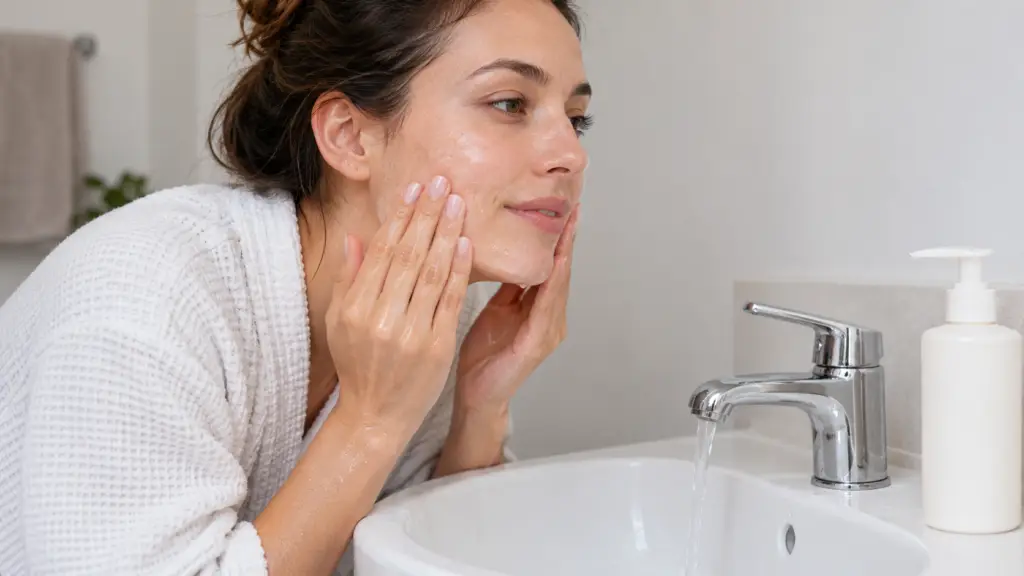
When Can I Wash My Face After Botox?
Gentle face washing is generally acceptable; the important distinction is avoiding rubbing treated areas. Keep the process light rather than treating cleansing as an opportunity for facial massage.
Keep cleansing separate from more intensive skincare:
- Use light contact rather than scrubbing or massaging treated areas.
- Ask separately about cleansing brushes and exfoliating tools.
- Clarify when to restart active products in your usual routine.
- Share product names or label photographs if you need specific advice.
Permission to wash gently does not automatically mean every part of your skincare routine can resume.
How Long After Botox Can I Wear Makeup?
Follow Lux’s instruction to avoid heavy makeup for 24 hours. Medical advice varies on exact timing, so do not replace your clinic’s protocol with a shorter waiting period found elsewhere.
If you have an event coming up, clarify:
- Whether you need full foundation or only a small amount of makeup.
- Whether concealer would be applied directly over injection sites.
- Whether eye makeup overlaps a treated area.
- Whether another procedure adds a different makeup restriction.
Ask before the appointment so you can plan around the event.
Can I Drink Alcohol After Botox?
Lux recommends avoiding alcohol for 24 hours. Cleveland Clinic also advises skipping alcohol on treatment day because of bruising concerns.
If you have dinner or a celebration planned, arrange the appointment so you can follow the clinic’s instruction. Plan around the clinic’s waiting period.
If you already drank alcohol, explain the timing to your injector if you are worried. Do not add supplements or change medicines to try to offset it without medical advice.
When Can I Use Retinol After Botox?
There is no universal retinol restart time established by the two medical sources used for this guide. Lux’s published Botox instructions also do not specify one, so confirm when to resume your particular product.
To get a useful restart plan, provide:
- Product name and strength, including whether it is prescribed.
- Usual frequency, such as nightly or twice weekly.
- Other active skincare, including exfoliating acids.
- Other procedures performed at the appointment.
- Current symptoms, such as discomfort at a treated area.
Ask for a product-specific plan rather than assuming another person’s retinol waiting period applies to your routine.
Botox Results and Recovery Timeline
The results timeline is different from the aftercare timetable. Completing a four-hour or 24-hour restriction does not mean the cosmetic effect is ready to assess.
Immediately After Treatment
Pain, swelling or bruising at an injection site and a headache can occur. Note what you are experiencing and contact the clinic if you are unsure about it, especially if symptoms worsen.
Keep your treatment details available. If you need advice, it helps to know the date, product and areas treated rather than simply saying you “had injections.”
The Following Days
Botox begins working gradually. Lux describes initial changes within several days; the exact onset varies. Avoid treating an immediate mirror check as your final result.
For a useful photograph comparison, keep these consistent:
- Camera angle and distance.
- Lighting.
- Facial expression.
Comparing a raised eyebrow with a relaxed face can make the result difficult to interpret.
Days 10–14: Your Results Review
Lux’s published information places peak results around days 10–14 and includes a 14-day follow-up. Use that review to discuss whether the result matches your goals and whether any further assessment is needed.
Prepare a short list for the review:
- Which area concerns you?
- When did you first notice the change?
- Is it an appearance concern, a symptom or a change in function?
- Does the outcome match the goals discussed before treatment?
A review supports a clinical decision; it is not an automatic promise of more injections.
How Long Does Botox Last?
The effect commonly lasts around three to four months, although individual duration varies. Do not treat a predicted duration as a guarantee for your own appointment.
Record when you first notice the effect wearing off and discuss that pattern with your injector. It helps distinguish a question about maintenance from an early question about whether the initial treatment has taken effect.
Avoid buying a new aftercare product on the assumption that it will reliably add months to your results. Ask what evidence supports any duration claim before making it part of your routine.
Maintenance is individualized. Mayo Clinic describes follow-up injections spaced at least three months apart; your treating clinician should decide the appropriate interval for your treatment.
A two-week results review and a later maintenance appointment serve different purposes. Tell your injector about any recent treatment elsewhere before discussing additional injections.
Decide what you want to maintain and what changes you are comfortable with. Those preferences belong in the consultation alongside the clinician’s assessment, rather than being replaced by a fixed calendar reminder.
Is Botox the Best Treatment for Fine Lines and Wrinkles?
There is no single best treatment for fine lines and wrinkles for every patient. Botox temporarily relaxes muscles involved in expression lines, but choosing your next treatment requires an assessment of the concern you want to address.
If you are also considering microneedling, discuss the purpose and timing of that procedure with your clinician. Do not add another treatment simply because an early Botox result looks different from your expectations.
Keep the current appointment’s recovery plan separate from future treatment decisions. Your results review is a useful time to ask whether your remaining concern needs a different approach.
When Should You Contact the Clinic or Seek Urgent Help?
Seek urgent medical attention for:
- Difficulty breathing, swallowing or speaking.
- Signs of a serious allergic reaction.
- New vision problems or widespread muscle weakness.
Warning symptoms may arise after the appointment day. Do not wait for a scheduled results review if you are experiencing them.
Contact your injector about:
- Eyelid drooping.
- Worsening injection-site symptoms.
- Concerns about your cosmetic outcome.
Describe the symptoms and when they began so the clinic can advise on the next step.
Get an Aftercare Plan That Fits Your Appointment
Keep your instructions accessible, plan around the first-day restrictions and use your results review to discuss how the treatment has developed. If you are uncertain about a product, activity or symptom, ask for advice that reflects your own appointment.
You can contact Lux Beauty Skin to clarify your recovery instructions or arrange a results review. Call 647-679-1664 with your treatment details available. This article provides general education and does not replace your treating clinician’s advice.
FAQs
Ask the clinic to send them again. Include your treatment date so the team can clarify which restrictions still apply and whether another procedure changes the advice.
Normal expressions are generally acceptable. You do not need to hold your face completely still or invent an exercise routine to make the treatment work.
Do not change prescribed medication on your own. Ask the clinician responsible for it and tell your injector what you take.
An immediate lack of visible change is not a reason to arrange more injections. Discuss your progress at the planned review, or contact the clinic earlier if you have a specific concern.
Give your treatment date, product if known, areas treated and the question or symptoms you have. For skincare, include the product name; for exercise, explain the activity and timing.