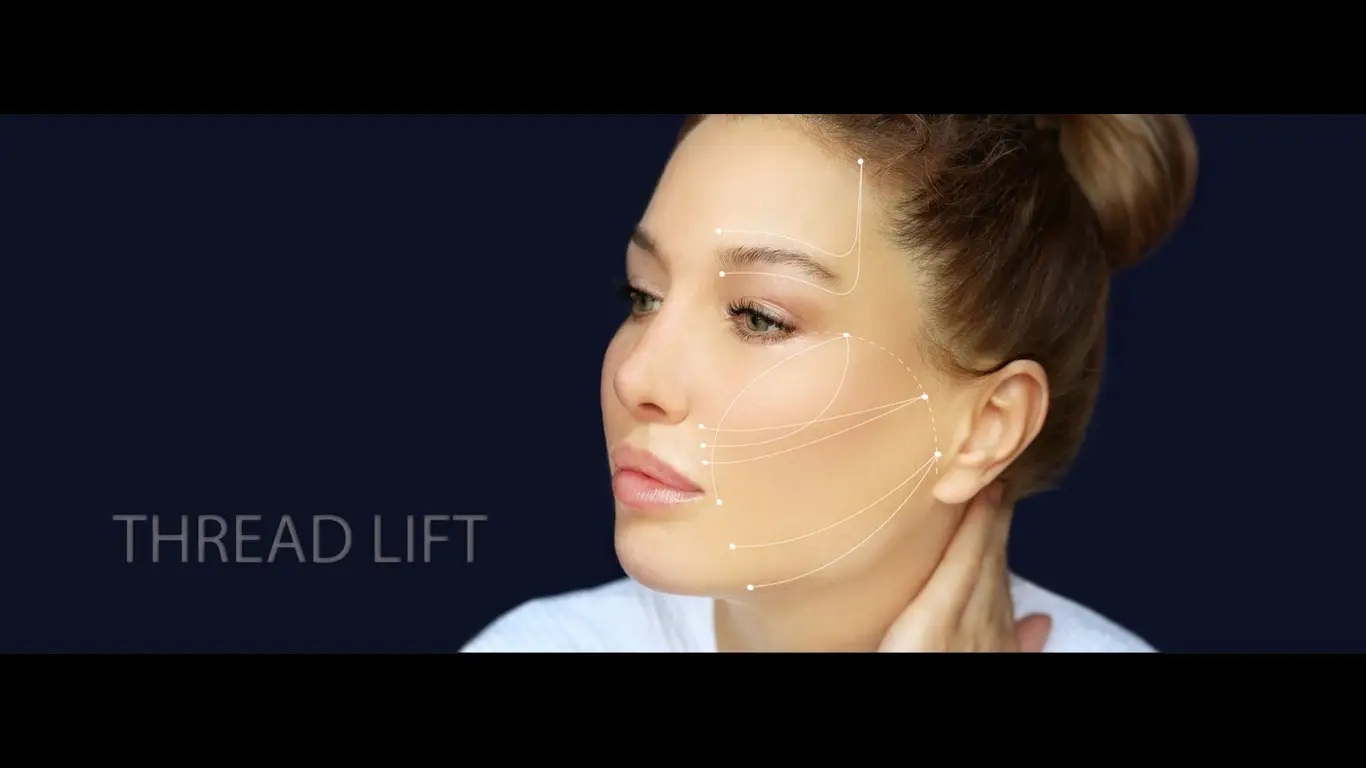
Non-Surgical Face Lift Toronto: Thread Lift vs Sculptra vs Radiesse


When you look in the mirror and notice that your cheeks seem flatter, your jawline less defined, or your lower face slightly heavier than it used to be, “facelift” may be the first word that comes to mind. But surgery is not the only option.
A non surgical face lift in Toronto can mean different things depending on what is actually changing: mild skin laxity, facial volume loss, early jowls, or reduced definition through the cheeks and jawline. A thread lift, Sculptra, and Radiesse can all play different roles. The right choice depends less on which treatment is “better” and more on what your face needs most.
This guide helps you understand where each option may fit, what it cannot do, and when a consultation is the sensible next step.
Table of Contents
ToggleQuick Answer
A non-surgical face lift is not one single treatment.
| If your main concern is… | A treatment that may be considered | Why |
|---|---|---|
| Mild skin laxity or tissue descent | Thread lift | Threads can provide physical support and reposition selected areas |
| Gradual facial volume loss | Sculptra | It works gradually by stimulating collagen production |
| Jawline definition or structural contour | Radiesse | It can provide immediate structural support in appropriate treatment areas |
| More advanced skin laxity or significant jowls | Assessment first | Non-surgical options have limits and may not replicate a surgical facelift |
No injectable or thread treatment can reliably replace the lifting effect of surgery where there is significant excess skin or advanced tissue descent. A qualified assessment should determine whether the concern is mainly laxity, volume loss, structure, skin quality, or a combination.
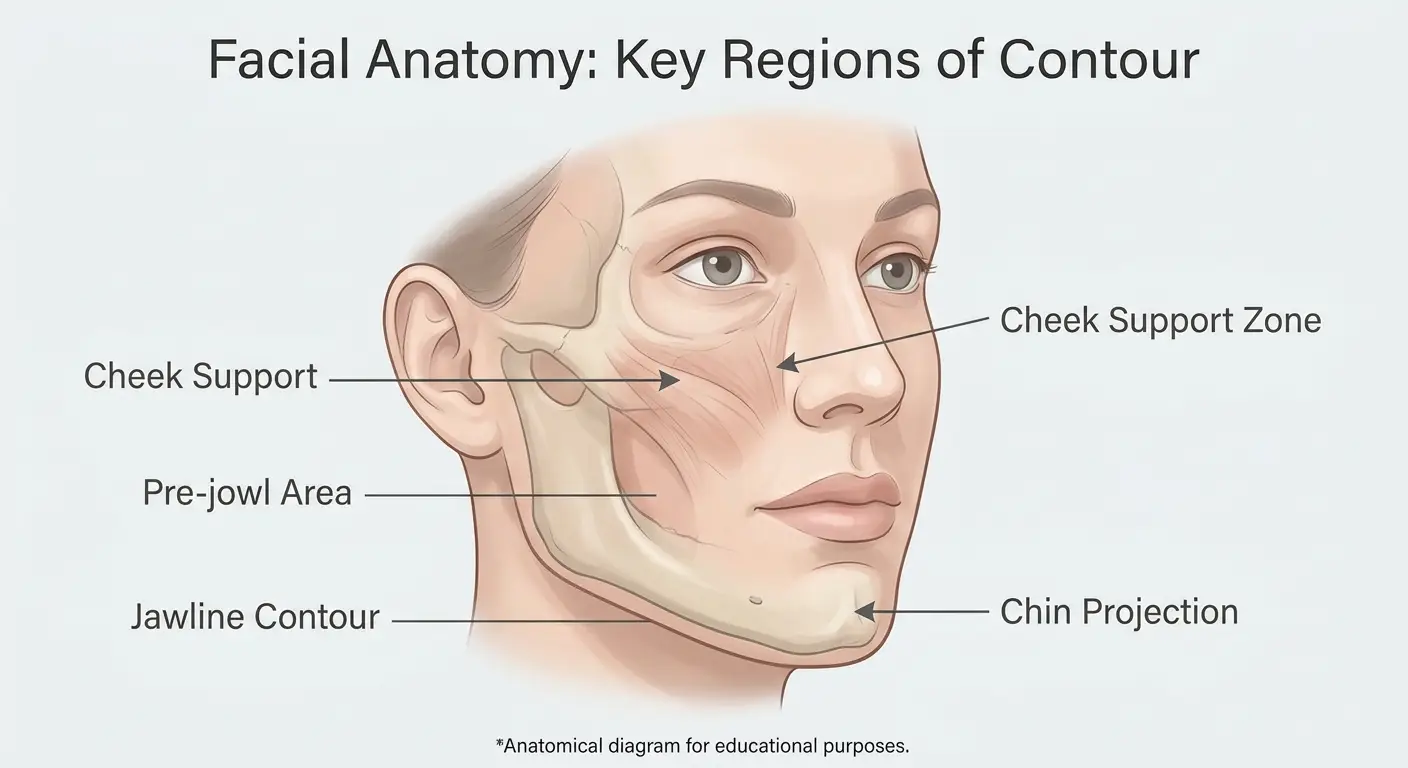
What does a non-surgical face lift actually treat?
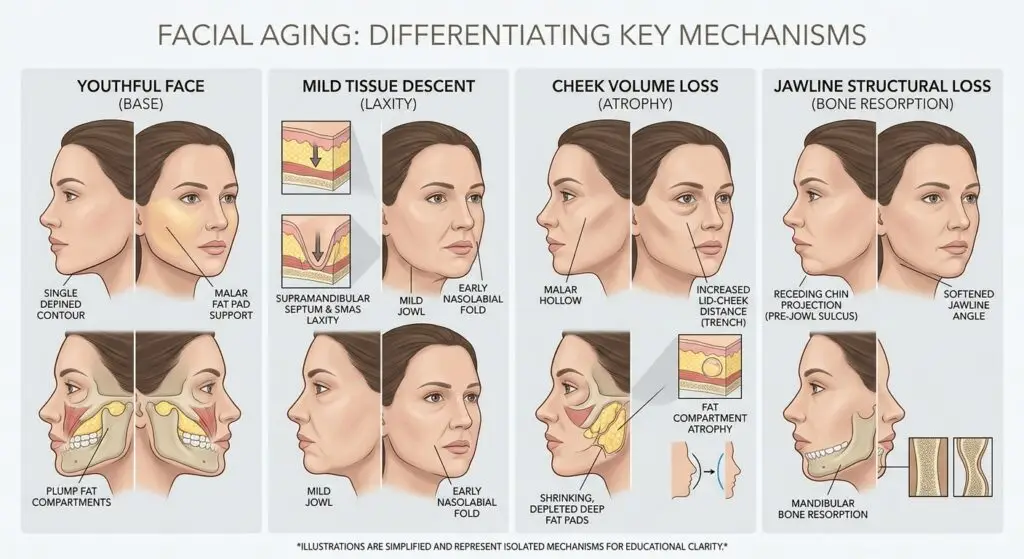
The phrase “non-surgical facelift” is often used broadly, but it can be misleading. Facial aging does not happen for one reason.
Some people notice that their mid-face has lost fullness. Others have early jowls, looser skin, downward movement through the cheeks, or less definition along the chin and jawline. These changes need different approaches.
A treatment for sagging skin on the face may not be the same as a treatment for facial volume loss. Adding volume to an area that mainly needs lifting can look heavy. Using threads when the real concern is hollowing may not create enough support or balance.
The most natural-looking plans usually start with identifying the dominant concern rather than choosing a treatment by name.
How does a thread lift compare with Sculptra?
The main difference in a thread lift vs Sculptra comparison is how each treatment approaches facial aging.
A thread lift uses absorbable threads placed beneath the skin to support and reposition selected tissue. It may be considered for mild-to-moderate laxity, early descent in the cheeks, or a softening jawline. Some visible change may be noticeable relatively soon, while collagen response develops over time.
Sculptra does not mechanically pull or reposition skin. It is a collagen-stimulating injectable used to gradually improve volume support and skin quality. It may be considered where facial volume loss, hollowing, or diffuse loss of structure is more noticeable than loose skin.
In simple terms: threads are generally considered when a patient’s main issue is position, while Sculptra is more relevant when the main issue is volume and gradual collagen support.
When might a thread lift be the better fit?
A thread lift may be worth discussing if you are noticing early cheek descent, mild jowling, or a softer lower-face contour but still have reasonable skin quality and elasticity.
A thread lift for sagging cheeks may help selected patients who want a subtle lift without surgery and understand that results are not equivalent to a surgical facelift. It is usually not ideal for someone with substantial skin excess, advanced laxity, or very heavy tissue in the lower face.
Timing matters. In many cases, people who seek a thread lift before laxity becomes advanced may be more likely to achieve a subtle, proportionate result than those expecting a major correction later.
At Lux Beauty Skin, the Threadlift service page describes PDO threads used strategically to help lift and tighten sagging skin while supporting collagen stimulation over time.
When might Sculptra be the better fit?
Sculptra may be considered when the face has gradually lost softness and support rather than simply “dropped.” Common examples include flatter cheeks, temple hollowing, a more tired appearance, or reduced facial fullness after weight changes or natural aging.
Sculptra for facial volume loss is not designed as an instant lift. Instead, it is placed strategically to stimulate collagen over a series of treatments, with results developing gradually. Lux Beauty Skin’s Sculptra service page describes its role in gradual volume restoration and collagen stimulation, with results that may last up to two years depending on the individual and treatment plan.
This gradual change can appeal to people who prefer subtle improvement over time. It also means patience is important. If you have an event next week and expect a dramatic visible lift, Sculptra alone may not match that timeline.
What is the difference between Sculptra and Radiesse?
Both Sculptra and Radiesse are commonly discussed as collagen-stimulating injectable options, but they are not interchangeable.
Sculptra contains poly-L-lactic acid and is typically used for gradual collagen stimulation and diffuse restoration of facial support over time. It is often part of a longer-term plan rather than a one-visit contouring treatment.
Radiesse is a calcium hydroxylapatite injectable implant. It may provide more immediate structural support in suitable areas while also supporting collagen stimulation. Health Canada’s regulatory information identifies Radiesse as a licensed injectable implant, and Canadian use should follow the product’s authorized indications and a qualified provider’s clinical assessment.
In a Sculptra vs Radiesse decision, think about the treatment goal:
-
Choose a Sculptra discussion when gradual volume restoration and collagen support are the priority.
-
Consider a Radiesse discussion when structural support, contour, or selected lower-face definition is the priority.
-
Do not choose based only on what is trending online; product selection depends on anatomy, tissue quality, medical history, and the area being treated.
Can Radiesse help define the jawline?
Radiesse for jawline contouring may be considered for adults who have appropriate anatomy and want more structure along the lower face. It can be useful where the jawline needs support or definition rather than simply more volume.
However, a soft jawline can have several causes. It may relate to jowls, chin projection, skin laxity, submental fullness, or a combination of these. Radiesse may help one part of that picture, but it will not remove excess skin or permanently correct significant jowling.
A careful injector assesses profile balance, chin support, lower-face movement, skin thickness, asymmetry, and the relationship between the jawline and neck. Treatment should enhance the face’s existing proportions rather than create an overly sharp or artificial result.
Which option may help with jowls?
For a non surgical treatment for jowls, there is no universal answer.
Early jowls caused mainly by mild tissue descent may lead to a thread-lift discussion. Jowls that appear more prominent because the cheeks have lost support may require a broader approach, sometimes including volume restoration. When poor jawline definition is the dominant concern, structural contouring may be assessed.
The key is to avoid treating the visible jowl in isolation. The cause may be higher in the face, in the chin, or in changes to skin quality.
This is why the answer to “thread lift vs Radiesse” is not simply that one is better. A thread lift may address selected tissue descent, while Radiesse may support structure in an appropriate lower-face plan. Some people may be candidates for a staged combination; others should wait or consider a different option.
What we actually see at Lux Beauty Skin
In real consultations, patients rarely fit neatly into one treatment category.
Someone may arrive asking for a thread lift because they feel their face looks “dropped,” but assessment may show that cheek-volume loss is creating that impression. Another person may request filler for jowls when mild laxity, not lack of volume, is the more important factor.
At Lux Beauty Skin, the goal is not to chase a dramatic or overfilled look. We look for balanced, natural-looking improvement that respects facial anatomy and the way each person’s face moves and ages.
Results vary with skin quality, degree of laxity, facial structure, age, lifestyle, prior treatments, and how the body responds. A treatment plan should be individualized, and sometimes the most responsible recommendation is to treat conservatively, stage the plan, or wait.
When is the right time to treat?
It may be a reasonable time to book a consultation if you have early changes that are bothering you consistently, realistic expectations, and enough flexibility to allow results to develop gradually.
You may be a better candidate for a non-surgical approach when:
-
Skin laxity is mild to moderate rather than advanced.
-
You want a subtle improvement rather than a surgical-level transformation.
-
You understand that maintenance may be needed.
-
You are open to a treatment plan based on your anatomy instead of a single product request.
-
You can plan around potential bruising, swelling, tenderness, or social downtime.
When should you wait or not rush?
It may be better to delay treatment if you are pregnant or breastfeeding, have an active skin infection or inflammation near the treatment area, are healing from a recent procedure, or have a medical history that needs review before injectables or threads.
You should also pause if your main expectation is to achieve the same result as a surgical facelift without surgery. A non-surgical plan can be helpful for selected concerns, but it has limits.
For thread lifts in Canada, Health Canada has specifically advised that only absorbable threads authorized for cosmetic use should be used, and it states that the authorized cosmetic thread product should be administered by a physician or used under physician supervision. The College of Nurses of Ontario also notes that product authorization in another country does not automatically apply in Ontario; Health Canada authorization is the relevant standard for Canadian use.recalls-rappels.canada+1
How long do results last?
Results vary, so no clinic should promise an exact timeline.
Thread-lift results may include an earlier visible lifting effect, followed by gradual collagen-related changes. Longevity varies with the thread type used, the treatment area, the degree of laxity, and individual factors.
Sculptra develops gradually and is commonly used as a longer-term collagen-support option. Lux Beauty Skin notes that its effects can last up to two years, though individual results and maintenance needs vary.
Radiesse can provide visible structural support sooner in appropriate areas, while its collagen-related effects develop over time. Product selection and expected duration should be discussed during consultation rather than estimated from a general online timeline.
Cost planning for a non-surgical face lift
There is no single price for a non-surgical face lift because there is no single treatment plan.
Thread-lift cost usually depends on the type and number of threads, the areas being treated, and the degree of correction being planned. Sculptra pricing is often based on the number of vials recommended over one or more sessions. Radiesse cost is commonly influenced by the amount of product required and whether treatment involves one focused area or a broader contouring plan.
A lower initial price does not necessarily mean better value. The appropriate number of threads or amount of injectable product should be based on anatomy, safety, and treatment goals—not on a package price alone.
A consultation should provide a personalized plan, realistic timeline, expected maintenance needs, and a clear cost estimate before treatment.
FAQs
Neither is automatically better because they address different concerns. A thread lift may be more relevant for selected cases of mild tissue descent or sagging, while Sculptra may be more suitable when gradual volume restoration and collagen support are the main goals. Some patients have both laxity and volume loss, so a staged combination may be discussed. The right option depends on facial anatomy, skin quality, desired timing, previous treatments, and realistic expectations.
The most suitable option depends on how much laxity is present and why the face appears to sag. Mild tissue descent may lead to a thread-lift discussion, while facial volume loss can sometimes make sagging look more pronounced and may require volume support instead. Significant skin excess or advanced jowling may not respond enough to non-surgical treatment. A qualified assessment is essential because the goal should be appropriate improvement, not a promised surgical-style lift.
Jowls can result from several overlapping changes, including tissue descent, loss of cheek support, jawline anatomy, skin laxity, and chin projection. A thread lift may be considered for selected early laxity; Sculptra may help where volume loss contributes to the overall appearance; and Radiesse may be assessed for structural lower-face contouring. The best choice depends on the cause of the jowls rather than the product name or a one-size-fits-all trend.
In selected cases, treatments may be combined or staged because they serve different purposes. For example, one treatment may focus on tissue support while another addresses facial volume or contour. However, combination treatment is not automatically necessary or suitable for everyone. A safe plan considers skin condition, facial anatomy, previous injectables, medical history, budget, recovery time, and how much correction is realistically achievable without surgery. Treatment should always be individualized and paced appropriately.
Ask what is causing the concern you see: skin laxity, volume loss, facial structure, or several factors together. Ask which treatment is being recommended and why, what alternatives exist, when results should appear, what maintenance may involve, and what risks or downtime to expect. You should also ask about the product’s Health Canada status where relevant, provider qualifications, complication protocols, total cost, and what the treatment cannot realistically achieve. A thoughtful consultation should make you feel informed rather than pressured.